
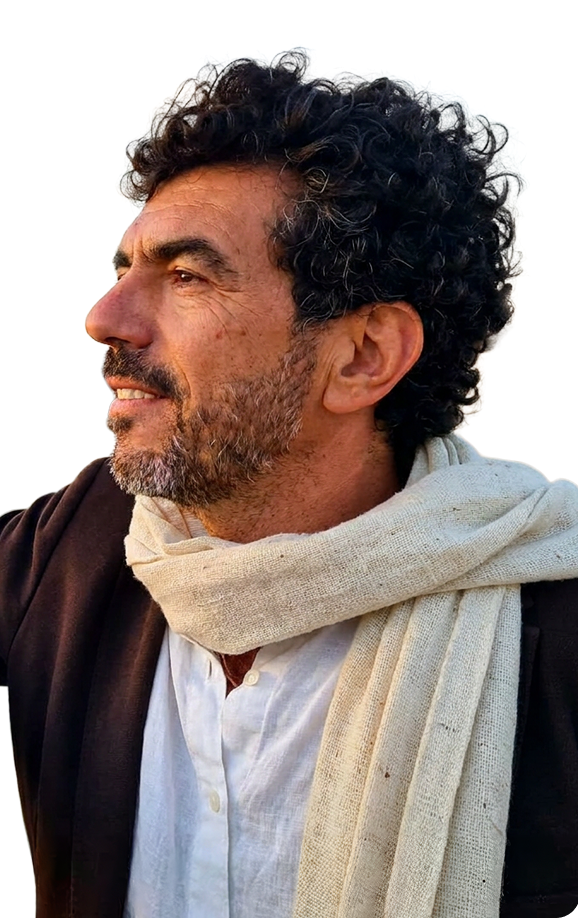
Meet Sulaiman Khatib
Sulaiman “Souli” Khatib is a Palestinian former prisoner and co-founder of Combatants for Peace whose life’s work turns pain, imprisonment, and resistance into a vision of nonviolence and collective liberation.
We don’t need only to condemn reality. We need to find a way to change reality. And for that we need power.
Alon-Lee Green first discovered what organizing could accomplish while working in a Tel Aviv coffee shop.
He grew up with his twin brother, mother, and grandmother. His mother raised the boys alone and worked hard to keep the family in Tel Aviv, even when they struggled to afford life there. Alon-Lee remembers visiting classmates’ homes and becoming increasingly aware of how differently people in the same city could live.
As a teenager, he began working for a large café chain. The employees were not receiving all the overtime pay, weekend wages, and transportation benefits required by law. When Alon-Lee questioned the conditions, management told him that he was free to find another café.
Instead, he stayed and organized.
The company fired him, but a labor court ordered that he be reinstated. He returned to work and continued organizing alongside his colleagues. Nearly 300 employees joined the effort, and a six-week strike eventually produced a collective agreement.
For Alon-Lee, the victory was deeply personal. He had spent much of his childhood feeling that inequality was simply part of the world around him. The workers’ campaign showed him that unfair conditions were not necessarily permanent. People who felt powerless on their own could become difficult to ignore when they acted together.
He carried that lesson into the Israeli social protests of 2011, helping organize demonstrations that brought hundreds of thousands of people into the streets. Yet when the crowds dispersed without producing the change many had hoped for, Alon-Lee began to distinguish between protest and organization. A demonstration could express anger. A lasting movement had to develop relationships, local leaders, shared purpose, and the strength to continue after public attention moved elsewhere.
In 2015, he helped establish Standing Together with a group of Jewish and Palestinian activists. The movement grew from the belief that the injustices affecting their communities could not be confronted entirely apart from one another.
Alon-Lee does not claim to speak on behalf of Palestinians. He works alongside Palestinian leaders who speak from experiences he does not share. He has been careful to acknowledge that, as a Jewish Israeli citizen, he does not live with the restrictions, displacement, or military violence endured by Palestinians in Gaza or the West Bank.
He understands his particular responsibility differently: to organize within Jewish Israeli society, challenge racism and dehumanization there, and persuade people that Palestinian freedom is not a threat to their future.
That responsibility became more difficult after October 7.
Alon-Lee condemned the attacks on Israeli communities and understood the fear and grief that followed. At the same time, he rejected the idea that devastating Gaza or treating all Palestinians as enemies could make Israelis safe.
Standing Together began forming local Jewish-Arab solidarity groups. It supported Palestinian citizens who faced dismissal from work, disciplinary action at universities, harassment, or accusations of disloyalty. Its members collected humanitarian aid and later organized volunteers to protect aid convoys to Gaza when extremists attempted to block or attack the trucks.
Alon-Lee also became an increasingly visible presence at demonstrations calling for an end to the war and the return of the hostages. That visibility came at a cost. He has been detained and arrested at protests, subjected to campaigns of vilification, and threatened by far-right activists, including outside his home.
He does not compare those consequences with what Palestinian colleagues and communities have endured. But they have tested his commitment and exposed how difficult it has become to defend Jewish-Palestinian partnership inside Israel during a time of war.
Through it all, he has continued working closely with Palestinian organizers, including Standing Together’s Palestinian co-director, Rula Daood. Their partnership does not rest on pretending that their lives or positions are identical. It rests on the decision to build a movement together while remaining honest about the differences between them.
B8 of Hope supports Standing Together’s grassroots organizing and humanitarian work. We have also hosted Alon-Lee in Geneva, giving supporters the opportunity to hear directly from an activist working inside Israeli society to resist separation, fear, and political despair.
Alon-Lee’s activism remains rooted in the lesson he learned as a young café worker. People do not have to accept every reality presented to them as inevitable. When they organize, they can begin to change it.