The Simple Work of Being Human
During a field visit with Physicians for Human Rights Israel, one of B8 of Hope’s grantee organizations, I joined a mobile clinic traveling from Jerusalem to a Palestinian village near Jenin. What I witnessed was practical, exhausting, and deeply human: doctors, medical students, translators, and volunteers stepping into an unjust system and doing what they could.
“The hero of this story is simply our humanity. People being people and treating each other as people.”
I had been looking forward to this day for weeks: a day of being immersed in the hands-on work of one of our grantees, Physicians for Human Rights Israel, as they set up and operated yet another mobile clinic—this time deep in the West Bank, in a small village near Jenin.
I had asked if I should bring my ID for crossing into the West Bank.
“No,” my host told me. “We’ll be in a village just outside Area A. No need.”
She was, as it turned out, completely wrong.
After several hours of driving, we crossed into Area A, where we picked up Palestinian doctors and medical students, and began the long, winding journey through the West Bank. GPS was useless. Road signs looked about a hundred years old. Directions were given by locals we stopped along the way—some simply pointing us toward the next turn, others settling in for a long explanation of every turn we would need to take for the next hour.
I felt like we were going in circles, but somehow we were progressing. Eventually, we reached Kafr Taybeh, a small village just outside Jenin.
I was deep in the West Bank, in an area I had never been before, despite having grown up in Jerusalem. Jerusalem is not far on a map. But the lay of the land—checkpoints, roadblocks, borders, underdeveloped infrastructure, and the legal prohibitions that prevent Israeli citizens and permanent residents from entering Area A—make it a nearly impossible destination for most people who are not personally connected to the small villages and sprawling cities scattered throughout the area.
The village had organized for the clinic to be held in the school, and we pulled into the parking lot, which also served as a basketball court, with our minibus full of doctors—Israeli Jews and Palestinians, as well as Palestinians and medical students from the West Bank. We began unloading the day’s supplies: boxes upon boxes of medicine that would later be distributed through the mobile pharmacy.
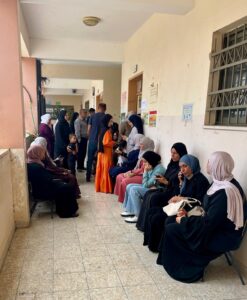
The school hallways were already packed with people: mothers and fathers, children, elderly people, whole families waiting for the doctors to begin.
After a short welcoming ceremony, in which the village leaders thanked the team for coming, spoke about the hardship of life under occupation, and blessed the doctors for coming to their village at this difficult moment in time, the clinic began.
The doctors dispersed to their classrooms, each marked by specialty: general medicine, gastroenterology, ophthalmology, pediatrics. Patients were received one family at a time.
I watched as an Israeli Jewish doctor sat with her Palestinian translator, trying to assess her first patient’s needs. He had severe back pain, wasn’t sleeping well, and wanted to know if he could have painkillers. She wrote him a prescription, gave him some advice, and sent him to the mobile pharmacy.
I watched the pediatrician, also an Israeli Jewish doctor, receive what seemed to be two related families at once and check each child one by one. He smiled at them, played little magic tricks—making their noses “disappear”—and managed to soften whatever fear was in the room. It was probably something he had done for decades with children everywhere, whoever they were and wherever they came from.
His translator, a young Palestinian medical student, was intent on learning from him, and he was happy to guide her without taking over.
“You know the answer,” he told her at one point, when she was faced with a question about one of the children. “Look inside her mouth. Look at her tongue. What do you see?”
She looked, paused, and then a huge smile spread across her face as she diagnosed the issue.
It was a moment of simple humanity. Just like everything else at the clinic that day.
The doctors later told me that they rarely encounter dramatic medical situations during these mobile clinic days. Mostly, people come for prescriptions—for medicine that is otherwise unavailable to them. Simple painkillers. Or, more disconcertingly, diabetes medication that had been missing in the West Bank for months.
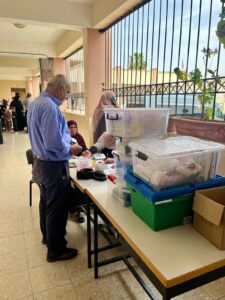
The doctors come to distribute medicine.
It is as simple as that.
But of course, it is more than that too.
Physicians for Human Rights Israel defends the right to health for all people living under Israel’s control, and its mobile clinics bring care to communities whose access to healthcare has been restricted or pushed out of reach. The medicine matters. The prescriptions matter. The practical care matters.
But so does the act of taking responsibility.
One Israeli Jewish doctor, who has been volunteering twice a week since 2000, told me he comes because he wants the Palestinians he treats to see him—to see an Israeli Jew taking responsibility for the unjust system they live under. Not in a symbolic way. Not instead of naming the injustice. But by doing something useful inside it, to change it.
The clinic lasted about three hours, and then the village leaders invited us to lunch in Jenin.
I was surprised and curious. I had only ever heard of Jenin in connection with military operations, hardship, and the refugee camp. As we drove through the city, I was struck by how much it reminded me of Ramallah: the streets, the shops, people simply trying to live their lives: Men gathered around a motorcycle, trying to fix it. A woman arranging oranges on her fruit stand. A little boy running down the road flying a kite.
As a child in Jerusalem, we used to fly kites on the abandoned hilltop outside our house. Seeing that boy in Jenin, in a place that had always felt so far away from me, collapsed something for a moment. Not the politics. Not the injustice. Not the reality of occupation. Just the distance we build in our minds between children who are, in the end, doing the same ordinary things.
Lunch was surreal: Jewish Israelis and Palestinians sitting at a long table on the second floor of a grilled chicken restaurant, eating, chatting, and laughing in Hebrew and Arabic, right there in the middle of Jenin.
I knew this was possible because of the people we were with—respected village council members. But perhaps people also knew PHRI. Perhaps they understood the anomaly for what it was: Israeli Jews, not in uniform, speaking Hebrew in Jenin after a day of medical care.
A human gesture. An act of compassion and resistance all at once.
It was an incredibly long day. By the time we began the journey back—another four and a half hours of driving—I was already exhausted. I found myself admiring the doctors, most of them retired, who have continued to volunteer their time to these mobile clinics for years, even decades. They push through the long drives, the tiring days, the traffic and frustration, to treat Palestinians living under the hard realities their own government has imposed on them.
But these doctors are not the heroes of the story.
The hero of this story is simply our humanity.
People being people and treating each other as people. With dignity, respect, and the hope that this connection—however small, however temporary—can still change something.
It was a privilege to travel with PHRI and see their work in action. I came away humbled by what they do, and deeply grateful that B8 of Hope has the opportunity to support them.